The Taking of Christ
Caravaggio (1602)
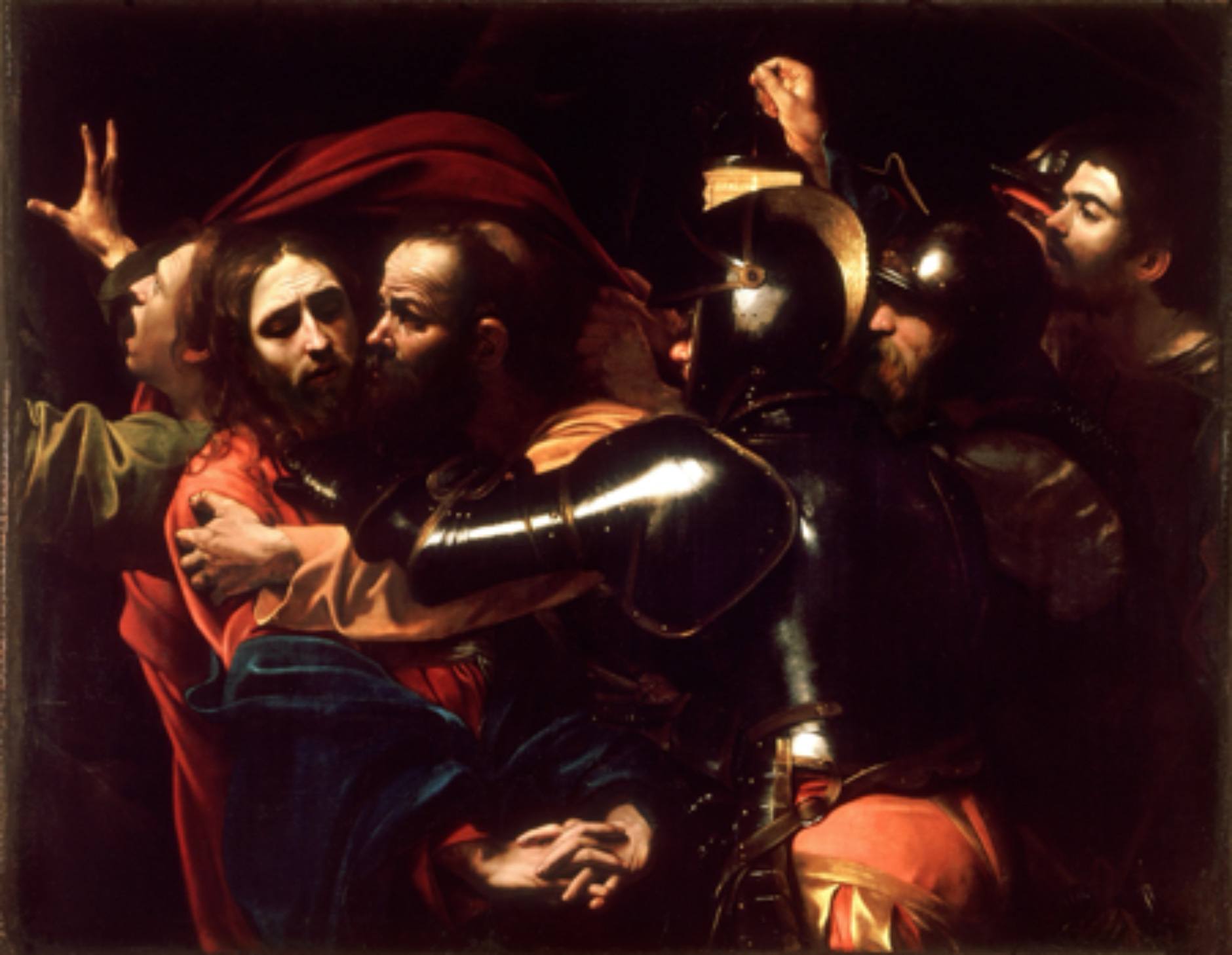
Discovered languishing in a Dublin Jesuit residence in 1990, this is one of the most vividly dramatic depictions of the Passion narrative we have. Left to right, we have St John, Christ, Judas, two soldiers and two onlookers (one almost entirely hidden). On the right is thought to be a self-portrait, as the artist casts himself as Hitchcockian witness and illuminator. The soldiers’ faces are almost entirely hidden, reduced to faceless function. Judas and Jesus share an uneven embrace, while John – the well-belovèd disciple – throws his arms and screams for help or justice. Look at the contrast between the faces of Christ and Judas: one tragically, nobly resigned; the other furrowed – the weakness of the flesh – and staring into eternity at the despair that will soon turn to suicide. Although there are only seven men here, the framing thrusts us (caravacteristically?!) into the claustrophobic centre of the event; we can almost hear the clanging armour and smell their breath. The hands! The artist dangles a lamp, Christ’s are joined in captivity and prayer, while Judas’s left hand grabs jealously, as if to say to his accomplices “here he is”, or to his master “why didn’t you love me”. In the centre is the first thing we notice: the miraculously real, polished armour plate. This is artistic genius, but also is it not a kind of mirror, asking the viewer to look inwards? The light it reflects might well come from you. This is painted the same year as Shakespeare published Hamlet, five short years before Monteverdi’s L’Orfeo. All three are putting humanity and its messy subjectivity more closely, more unforgivingly under the microscope. Here, Caravaggio offers a cast of fully living, breathing people, and asks us which we are. Are you betrayed or betrayer, onlooker or participant, damned or redeemed? The truth is likely somewhere in between. As Solzhenitsyn says, “…the line dividing good and evil cuts through the heart of every human being. And who is willing to destroy a piece of his own heart?”

