The Meditation of St Francis
Francisco de Zurbarán (1635-1639)
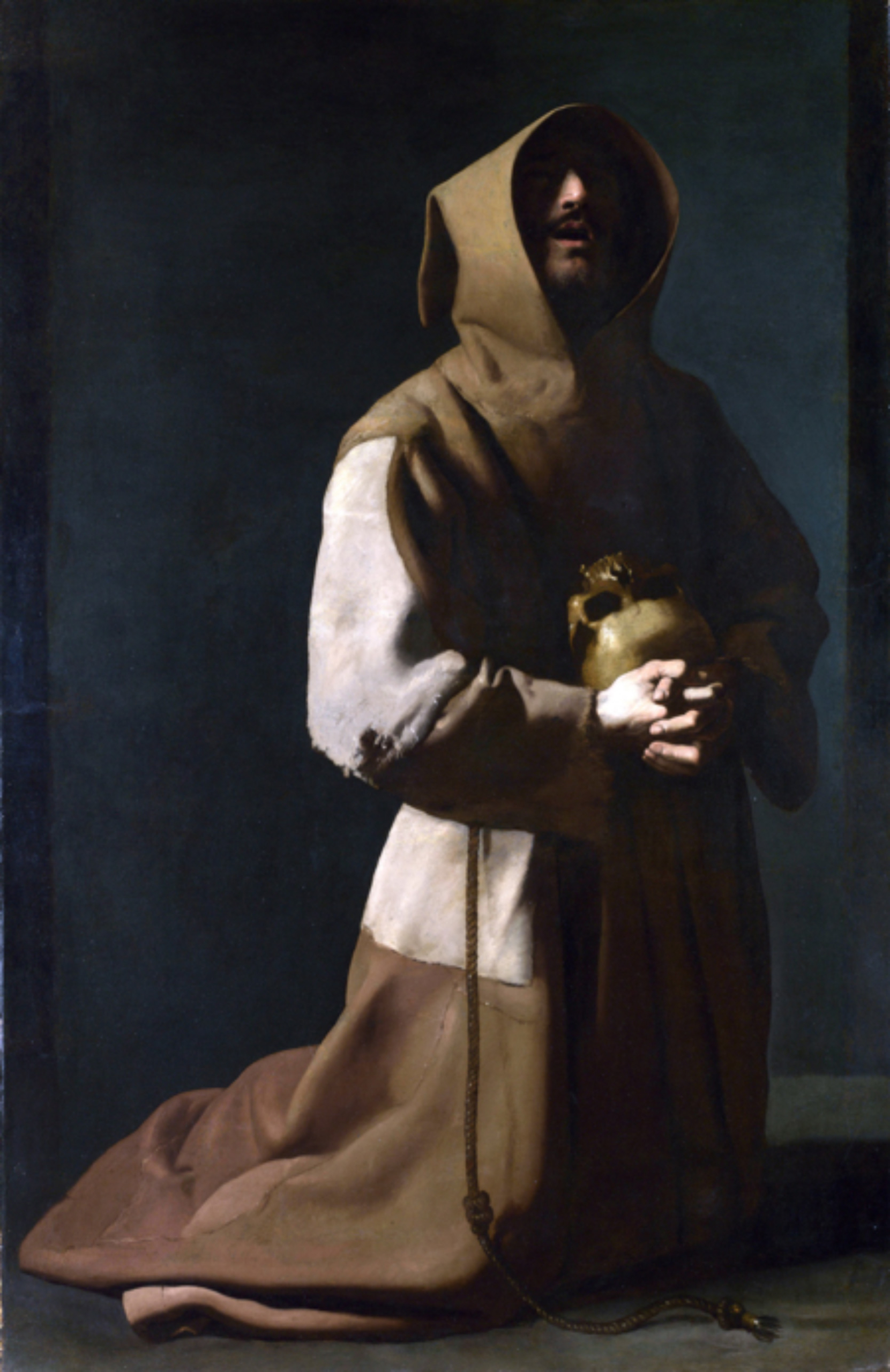
This is the star attraction at the National Gallery’s St Francis exhibition, an image that gives and gives as you look closer. There’s no theatrical context, just a man kneeing in the gloom of what must be his cell, and a small collection of meaningful items that are meticulously placed to pile meaning upon mystery. There’s his cloak, already a departure from historical truth: Francis founded his own order but this commission was for a Capuchin order in Seville, so the garment is cast in the house style. The habit wears the same expression as the saint: bedraggled, beleaguered, in need of repair. We can see two of the traditional three knots on the friar’s cord that denote humility, chastity and obedience. His rough hands (amazingly lifelike as if to emphasise at once the acts of prayer and painting) are clasped in prayer around the skull that chillingly reminds us that earthly life is futile and fleeting. Then, the face: almost entirely concealed (and therefore almost infinitely expressive), save for an open mouth – open in prayer, rapture, song, rebuke, who knows. Painting, at least in Zurbarán’s time, is usually about bodies and faces, but here we don’t see much of either. So we bypass the physical world and go to philosophical oppositions: death and life, doubt and faith, visible and invisible. Which brings us to the eyes. From a distance you might think you see them, but draw near and they vanish into a black void. Why? Maybe the artist’s trick is in nudging us to contemplate what we can’t see: the difference between sight and vision, a receptivity to moments of clarity, and – consistent with his monastic commission, this – to look not to the body, but for the soul.

