Resurrection
Piero della Francesca (1460s)
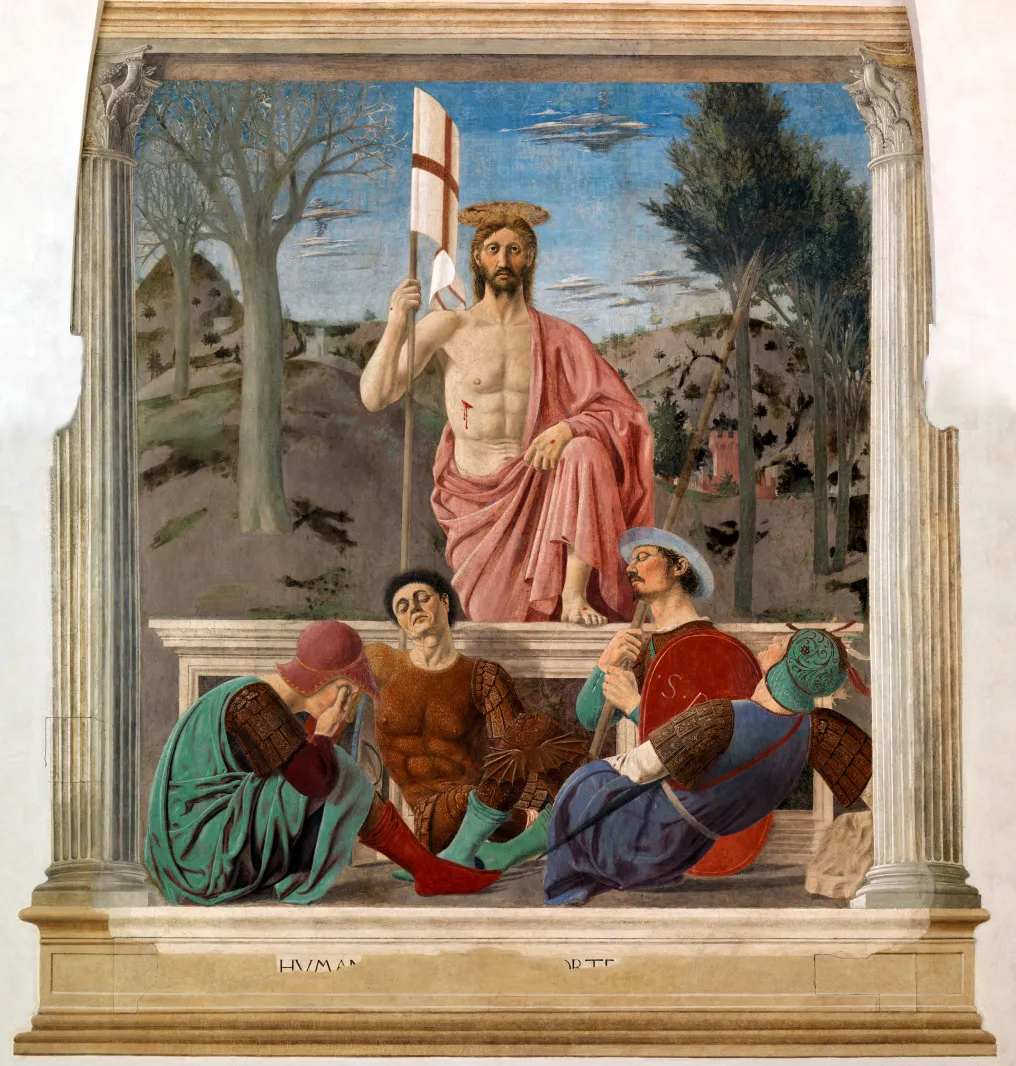
We’re overwhelmed constantly by images today, so it’s impossible to imagine the impact this one – quietly teeming with ideas – would have had when it was brand new. One of Piero’s innovations was to show physical mass and perspective thanks to a radical gift for light and an adherence to sacred geometric precepts. Let’s start there: Christ’s head is atop the symmetrical triangle in the foreground, and his rectitude – striding out of the tomb – is a telling contrast with the clump of sleeping soldiers, one of whom has no legs (how does he smell?!). Another is said to be a self-portrait. (Some viewers have suggested Christ’s left hand is gathering the soldiers up in an invisible net – you decide if that’s fishy or not.) His uprightness is also a visual counterpoint to the rolling hills that viewers would have recognised as Piero’s native Tuscany – the resurrection is here and now, for us, he might say. Look how on one side the trees sprout leaves: this is a story about renewal and rebirth. And then there’s the face of Christ: fixing us with intense silence and challenging us not to look away. His radiant, serene power, in fact, infects the entire picture, whose authority, unity and harmony were all hallmarks of Piero’s work. *Columbo voice* Just one more thing: in 1944, a soldier of the allied forces, Tony Clarke, was ordered to shell the aptly named town of San Sepolcro ahead of capturing it from the Germans. Before he did so, he remembered reading in Aldous Huxley that the town housed “the greatest painting in the world”, and refused the orders, thereby saving a priceless treasure, and giving this picture, which is all about lasting miracles, a second life of its own. The tale embodies something CS Lewis said, that “miracles are a retelling in small letters of the very same story which is written across the whole world in letters too large for some of us to see”.

