Supper at Emmaus
Caravaggio (1601)
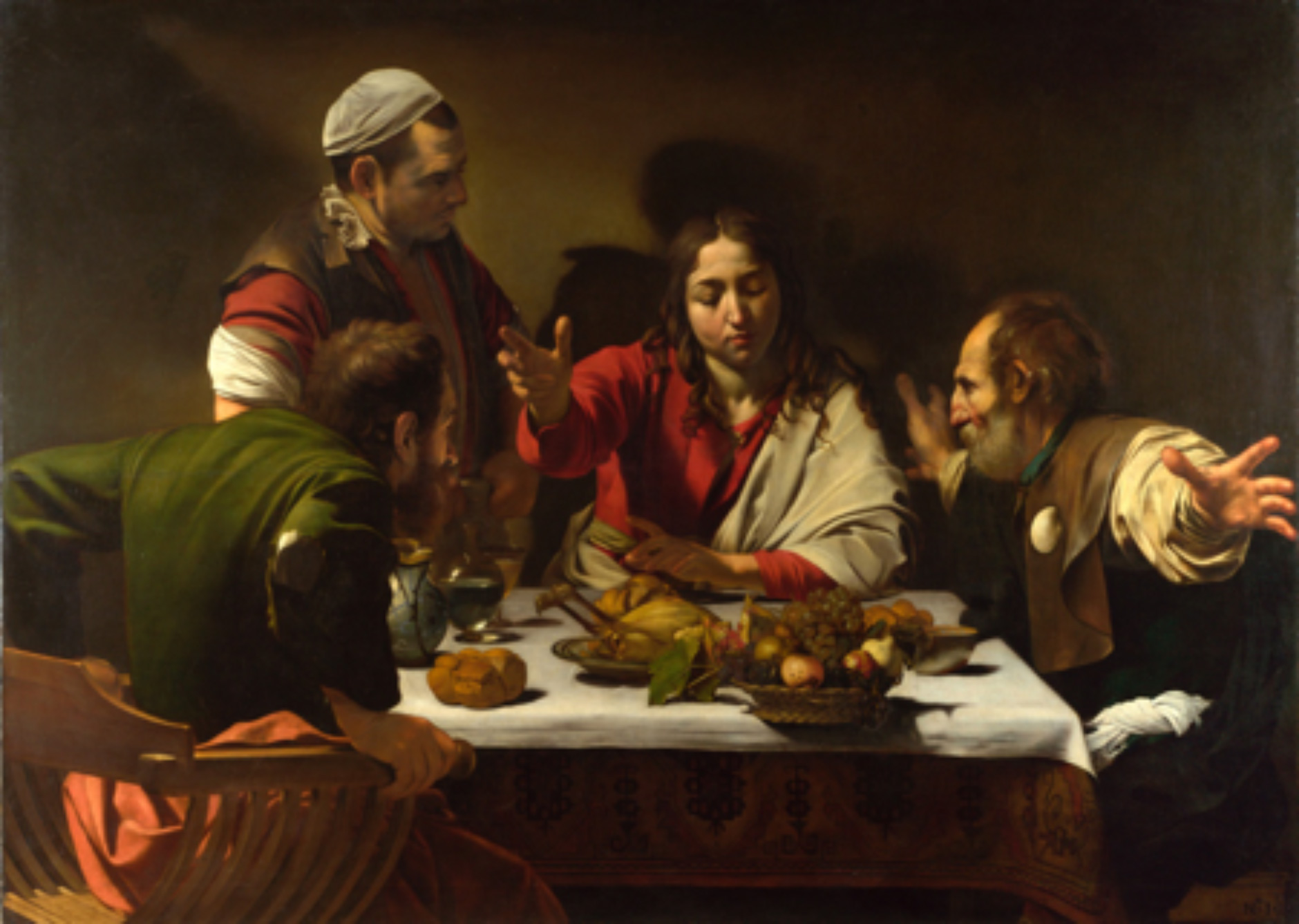
Signs and wonders. When does a meal become a sacrament? What happens when the veil between seeing and knowing, between earth and heaven, thins or is whisked away? Witnessing this staggering epiphany collapses the barrier between the act of painting it and the event itself. We are mid-penny-drop here, as Christ (unusually with no beard) reveals himself (not like that, no sniggering please) to two disciples and a sceptical innkeeper. The latter looks unimpressed, but unwittingly casts a shadow on the wall which becomes Christ’s halo. On the table, the flaw in the weave of the wicker basket casts another shadow on the table – the timeless Christian symbol of the fish. In the basket, the (first?) fruits are out of season; the prominence of imperfection might offer us a truth about the redemptive qualities of this episode. The uncannily realistic tear on the green garment and the coarsely woven waistcoat with the pilgrim’s shell contrast with Christ’s more noble elegance as he blesses the bread. The disciple on the right stretches out his arms, as if simultaneously to recall the crucifixion and measure the extent of his shock or the magnitude of his questions (or to signal a wide in cricket). The hand seems to come through the membrane of the painting towards us and his face is a wonder of mute anxiety and amazement. How and why does Caravaggio achieve this dramatic feat of theatrical or filmic lighting? We don’t see any light source, but the caravaracteristically dramatic contrast between dark and light is rich in meaning: it allows us see the most vivid of human emotions virtuosically etched on these faces, but it also allows us to feel we are there, too, in our own darkness, both visual and spiritual, from where we can see what the artist illuminates within this seismic meeting. Caravaggio is so good on this blur between seeing and knowing (he returned to the same scene a few years later with a bleaker outlook), and here he produces a searing hymn to light and colour, and to the range of human psychology (which of these men are you?). But this is mostly about time, and vision: an arresting, unforgettable embodiment of the radically transformative possibilities of a single moment for those whose eyes and hearts are open.
