Creation of Adam
Michelangelo (1511)
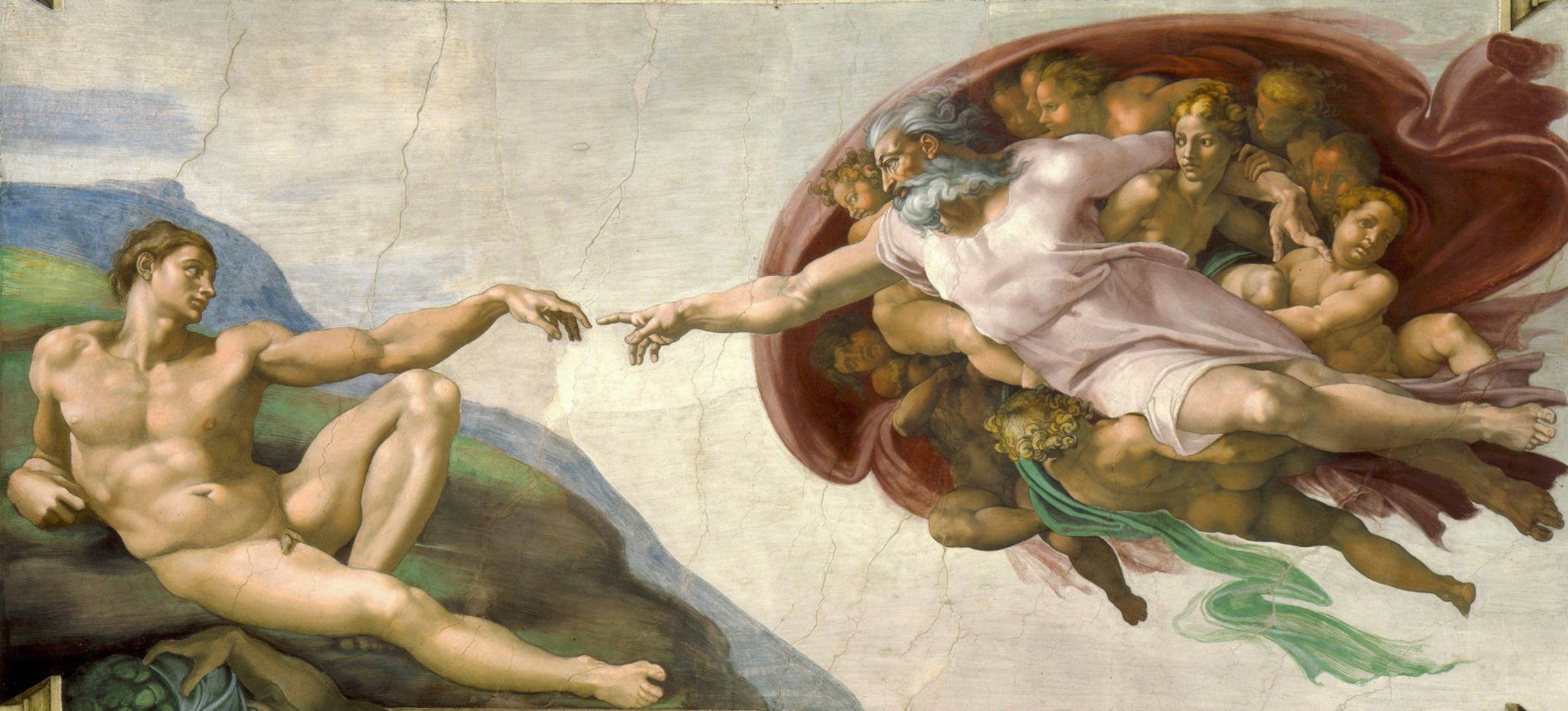
Alongside the Mona Lisa, this might be the most famous single image in western art. The two were painted less than a decade and a couple of hundred miles apart, which itself tells us a lot. But, where the Leonardo is all intimacy, mystery and obdurate privacy, this, in a way, is the most universal theme imaginable, all ostentation and painterly swagger. Michelangelo was meant to be sculpting a tomb for the Pope but was interrupted to paint (not even his speciality!) the ceiling of the Sistine Chapel, where twelve panels now depict central episodes in the genealogy of Christ. This ninja turtle undertook detailed study (we’d now call it scientific) of the human form – kinesis, musculature, anatomy – which we can see in every striving, twisting sinew of these forms. God stretches out from the assembly in his chariot – some say it has the topography of the human brain; others that it takes the form of the heart or the uterus (take your pick) – and creates Adam in his own mirror image. Contrast the motion and dynamism on the right with the inert passivity on the left, and the deliberately separate space each inhabits. Most of all, though, we’re dealing in two of the painter’s most priceless currencies: time and space. The artist freezes the moment before the Moment, all tension, poise, anticipation. And that 1.5cm of fresco between two outstretched fingers is electric, quivering with possibility, and bids us think about our own near misses, our longings and needs, our incompleteness. Even this tiny space is a metaphor for painting (where else can we see so clearly how something is willed into being?) and for the divinity of creation itself, an idea Michelangelo would have fully embraced. Finally, it acts as an embodiment of the instant that potential becomes reality, the drama of possibility, and an eternal reminder of Beckett’s idea that “the creation of the world did not take place once and for all time, but takes place every day”.

